
- Home
Edition
Africa Australia Brasil Canada Canada (français) España Europe France Global Indonesia New Zealand United Kingdom United States Edition:
Global
Edition:
Global
- Africa
- Australia
- Brasil
- Canada
- Canada (français)
- España
- Europe
- France
- Indonesia
- New Zealand
- United Kingdom
- United States
Academic rigour, journalistic flair
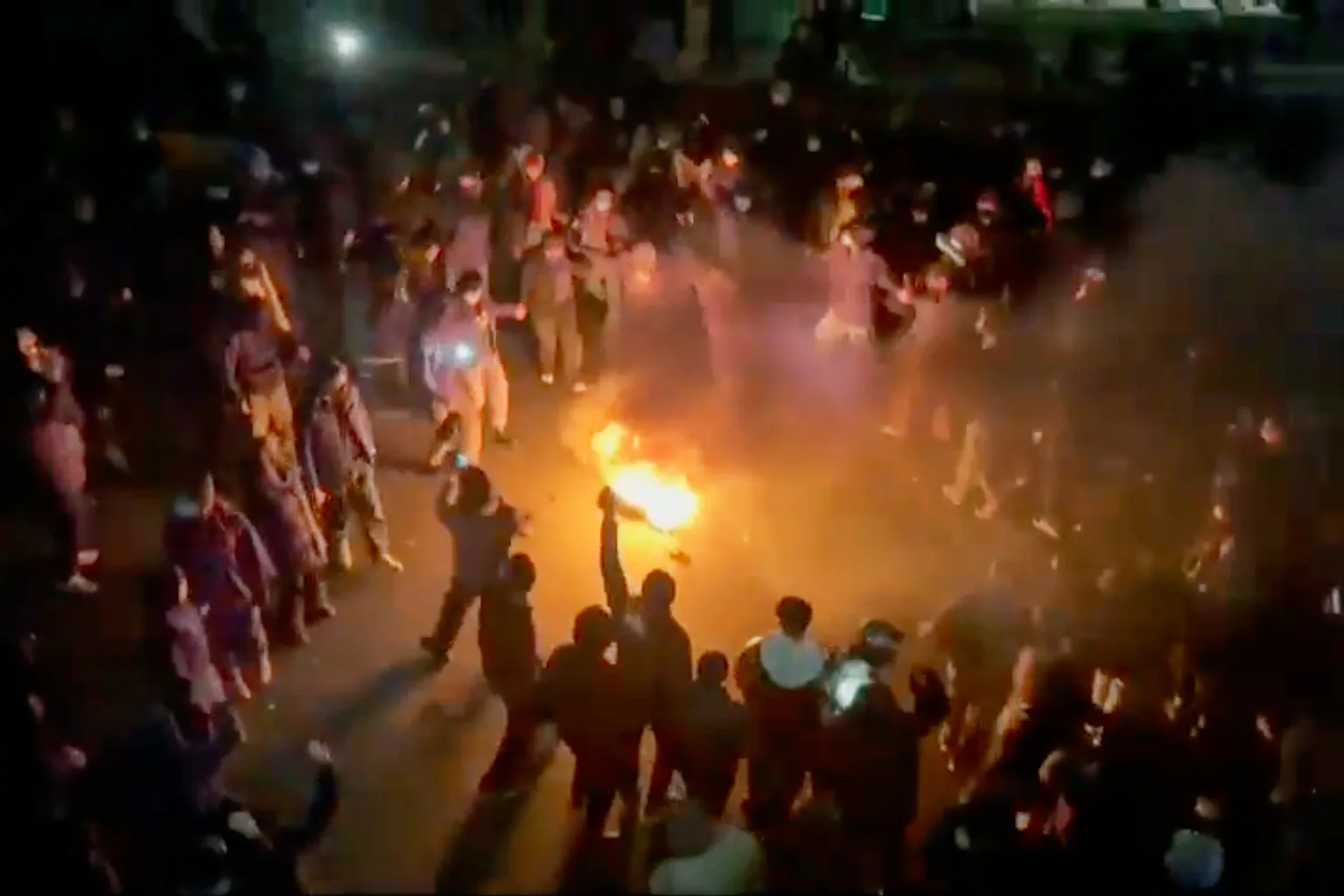 In this image taken from a video circulating on social media, protesters take to the streets despite increasingly severe repression, while the Islamic Republic remains cut off from the rest of the world, in Tehran, Iran, on January 9, 2026.
(UGC via AP, archive)
Protests in Iran: ‘Whatever happens, the situation will be explosive’
Published: January 14, 2026 4.49pm GMT
Francesco Cavatorta, Université Laval
In this image taken from a video circulating on social media, protesters take to the streets despite increasingly severe repression, while the Islamic Republic remains cut off from the rest of the world, in Tehran, Iran, on January 9, 2026.
(UGC via AP, archive)
Protests in Iran: ‘Whatever happens, the situation will be explosive’
Published: January 14, 2026 4.49pm GMT
Francesco Cavatorta, Université Laval
Author
-
 Francesco Cavatorta
Professor of Political Science, Université Laval
Disclosure statement
Francesco Cavatorta does not work for, consult, own shares in or receive funding from any company or organisation that would benefit from this article, and has disclosed no relevant affiliations beyond their academic appointment.
Partners

Université Laval provides funding as a founding partner of The Conversation CA-FR.
Université Laval provides funding as a member of The Conversation CA.
View all partners

Languages
- English
- Français
DOI
https://doi.org/10.64628/AAP.g7qxpx4h9
https://theconversation.com/protests-in-iran-whatever-happens-the-situation-will-be-explosive-273435 https://theconversation.com/protests-in-iran-whatever-happens-the-situation-will-be-explosive-273435 Link copied Share articleShare article
Copy link Email Bluesky Facebook WhatsApp Messenger LinkedIn X (Twitter)Print article
Iran has been rocked by unprecedented unrest since late December. Protesters from all regions and social classes have taken to the streets to denounce the economic crisis and political repression, defying the regime’s blockade of internet and telecommunications.
The country is in the throes of a deep economic crisis: currency devaluation, rampant inflation and growing inequalities are fuelling anger. Iranians are denouncing a regime that demands constant sacrifices but is unable to meet their needs.
The government has responded to this massive mobilization with violent repression. According to the latest estimates by human rights NGOs, the death toll from the crackdown has stood at more than 2,000 since the uprising began in late December, the vast majority of whom were protesters. More than 10,000 arrests have been reported across the country. However, the Norway-based NGO Iran Human Rights (IHR) estimates that the actual number of victims could be much higher.
In this context, United States President Donald Trump has threatened to “hit very hard” if the situation escalates, reigniting concerns about possible American intervention in the region.
To analyze these events, we interviewed Laval University professor Francesco Cavatorta, a specialist in the Middle East. He explains the causes of the movement, the regime’s strategies and the geopolitical issues at stake.
The Conversation Canada: What are the root causes of the current protest movement in Iran and how does it differ from recent uprisings in 2019 and 2022?
Francesco Cavatorta: The current movement is the latest episode in a long series of mobilizations in Iran, dating back to at least 2009. There have been periodic protests for two decades. This time, the intensity of the uprising is explained by the socio-economic situation and particularly the economic situation, which is affecting even parts of society that were previously privileged; namely, the merchant bourgeoisie and professionals.
These frustrations have been exacerbated by the recent Israeli and American bombings in the region. The population has been asked to make significant sacrifices, but foreign powers are doing what they want. The devaluation of the currency has also added to the discontent of people who would not normally have protested.
On social media, we are seeing many comments, such as “I don’t normally protest,” or “I have convinced my father.” Growing inequalities are weighing heavily everywhere, and even if the devaluation was the spark, the underlying conditions had already been in place for a long time.
Read more: Comment Téhéran a transformé une défaite militaire en victoire symbolique
TCC: How do you explain the scale and speed of the protests despite the regime’s internet blockade to contain the protests and limit the spread of images and information?
F.C.: There are two or three explanations. First, those who are active in the opposition have communication experience; they have been protesting for two decades. Second, even if the internet is limited, mobile phones are still working. People can film, exchange videos and talk to their loved ones.
And for once, state television is even broadcasting images of demonstrations, [both pro-government ones and ones that show buildings on fire]. Finally, the economic crisis is now affecting all neighbourhoods and regions, even those that thought they were immune. This is creating a shared sentiment, which explains the rapid spread of the protests.
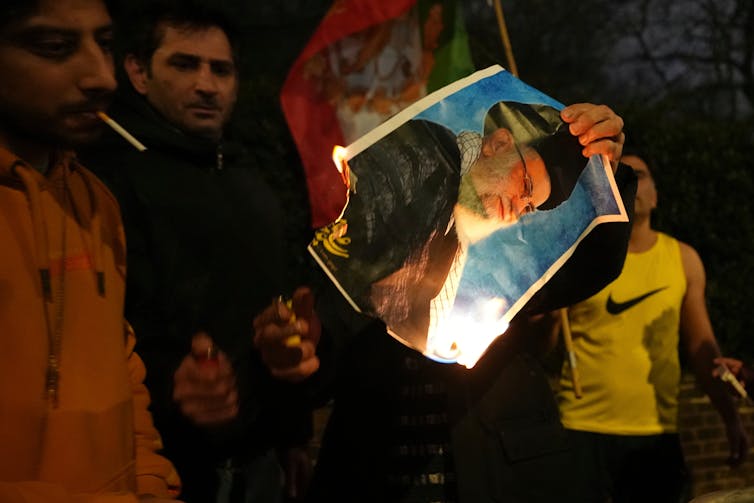 A photo of Ayatollah Ali Khamenei is set on fire by protesters outside the Iranian Embassy in London on Jan. 12, 2026.
(AP Photo/Alastair Grant)
A photo of Ayatollah Ali Khamenei is set on fire by protesters outside the Iranian Embassy in London on Jan. 12, 2026.
(AP Photo/Alastair Grant)
TCC: What real options does the U.S. have at its disposal, and what would the consequences be?
F.C. If we knew what the Trump administration was going to do, we’d be millionaires. It’s hard to predict what they’ll do. Impose more sanctions? Iran is already marginalized, particularly in the international banking system. Bomb whom, and what? The Ministry of the Interior? The headquarters of the Revolutionary Guard? But an attack could kill protesters and intimidate them without solving the underlying problem.
For the Trump administration, the idea of killing the Supreme Leader, Ayatollah Ali Khamenei, would solve nothing. The regime is stronger than we think, and direct intervention with soldiers would not be a good option. The history of Iraq shows the risks of this. And even if there was an intervention, its impact would be limited: the regime is not a single person, but a structured state apparatus.
TCC: What strategies are the Iranian security forces using and what are the implications of these?
F.C. Repression was already harsh before, with deaths in the streets, but not on this scale. Local figures were arrested, spectacular trials were organized and sometimes executions took place. Today, the security forces are firing point-blank at demonstrators, which shows the regime really feels it’s in danger.
There are two possible scenarios: either, as in Syria in 2011, the repression escalates and leads to a prolonged civil war. The other scenario is to do what happened in Algeria in 1989: the army fires, but the regime then attempts to reform itself to preserve its legitimacy by adopting a new constitution after the riots of October 1988. (Admittedly, a civil war broke out a few years later, in 1992, but for three years Algeria did undergo real change.)
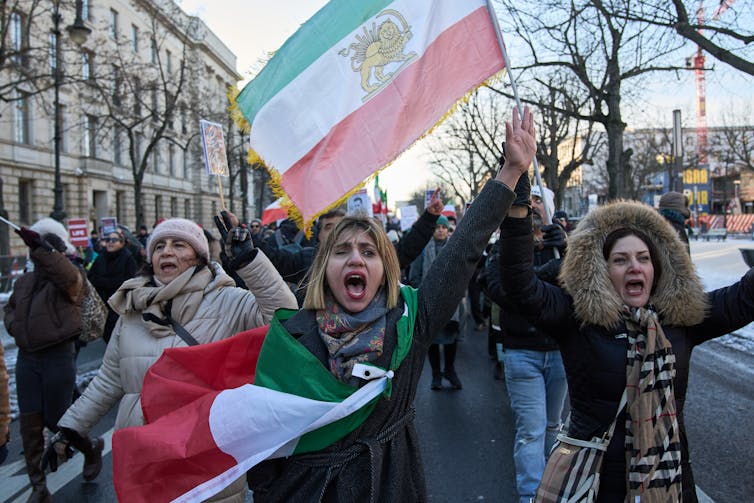 Demonstrators in Berlin stage a protest in support of Iranians on Jan. 11, 2026.
(AP Photo/Ebrahim Noroozi)
Demonstrators in Berlin stage a protest in support of Iranians on Jan. 11, 2026.
(AP Photo/Ebrahim Noroozi)
TCC: What role do the diaspora and external entities play in the movement?
F.C. The Iranian diaspora is very large and has been following the movement for a long time. Reza Pahlavi, the exiled son of the Shah of Iran during the 1979 Iranian Revolution, is trying to establish himself as a figurehead of the opposition. His name is often chanted during demonstrations in Iran.
But the regime has been in place for nearly 50 years. Those on the outside have less influence than before. There are no clearly identified national leaders: the demonstrators want, above all, the fall of the regime, but no one knows what will come next.
History shows that relying solely on exiles can be misleading, as in Iraq. For the moment, domestic mobilization remains the main factor.
Read more: Le régime iranien est un apartheid des genres. Il faut le dénoncer comme tel
TCC: What are the political prospects for the Iranian regime?
F.C. In the short term, it will be very difficult for the protesters. The repressive apparatus is working to ensure its survival. But the more it cracks down, the more it loses legitimacy. In the long term, anything is possible. A transition, if it happens, could be long and complex.
The 1979 Iranian Revolution and the fall of the Shah of Iran, Mohammad Reza Pahlavi, were not enough: it took a year or more of protests and compromises before the country found a new direction. The consolidation of the Islamic Republic was slow, since many forces with different ideologies had participated in the Shah’s downfall. After his departure, it took time for Khomeini to become the sole leader of the revolution and to impose his model of theocratic rule.
Whatever happens, the situation is explosive. This is a country of 80 million people, divided along ethnic and religious lines, with colossal oil reserves. I would not venture to make any predictions.
This article was originally published in French
- Protest
- Iran
- Islamic State
- Khamenei
- Repression
- Ayatollah Khomeini
Events
Jobs
-
 Postdoctoral Research Fellow or Research Fellow
-
Research Fellow - AI and Digital Capabilities
-
Data & Reporting Analyst
-
Lecturer/Senior Lecturer, Terrestrial Ecology
-
Video producer
 Postdoctoral Research Fellow or Research Fellow
 Research Fellow - AI and Digital Capabilities
 Data & Reporting Analyst
 Lecturer/Senior Lecturer, Terrestrial Ecology
 Video producer
- Editorial Policies
- Community standards
- Republishing guidelines
- Analytics
- Our feeds
- Get newsletter
- Who we are
- Our charter
- Our team
- Partners and funders
- Resource for media
- Contact us
-
-
-
-
Copyright © 2010–2026, The Conversation