
- Home
Edition
Africa Australia Brasil Canada Canada (français) Català España Europe France Global Indonesia New Zealand United Kingdom United States Skip to content Edition:
Global
Edition:
Global
- Africa
- Australia
- Brasil
- Canada
- Canada (français)
- Català
- España
- Europe
- France
- Indonesia
- New Zealand
- United Kingdom
- United States
Academic rigour, journalistic flair
 wellphoto/Shutterstock
Why isn’t the Greens’ growing success reflected in media coverage?
Published: February 27, 2026 5.51pm GMT
Maxwell Modell, Matt Walsh, Stephen Cushion, Cardiff University
wellphoto/Shutterstock
Why isn’t the Greens’ growing success reflected in media coverage?
Published: February 27, 2026 5.51pm GMT
Maxwell Modell, Matt Walsh, Stephen Cushion, Cardiff University
Authors
-
 Maxwell Modell
Research associate, Cardiff University
-
Matt Walsh
Head of the School of Journalism, Media and Culture, Cardiff University
-
Stephen Cushion
Professor, Cardiff School of Journalism, Media and Culture, Cardiff University
Disclosure statement
Maxwell Modell receives funding from the AHRC for research into broadcasters' impartiality.
Matt Walsh receives funding from the AHRC for research into broadcasters' impartiality.
Stephen Cushion has received funding from the BBC Trust, Ofcom, AHRC, BA and ESRC.
Partners

Cardiff University provides funding as a founding partner of The Conversation UK.
View all partners
DOI
https://doi.org/10.64628/AB.h4jtyudcg
https://theconversation.com/why-isnt-the-greens-growing-success-reflected-in-media-coverage-277137 https://theconversation.com/why-isnt-the-greens-growing-success-reflected-in-media-coverage-277137 Link copied Share articleShare article
Copy link Email Bluesky Facebook WhatsApp Messenger LinkedIn X (Twitter)Print article
The victory of the Greens in the Gorton and Denton parliamentary byelection is a landmark for the party. But our new research reveals the Greens have received limited airtime over the last year despite almost doubling their support in the polls and in party membership.
While Reform UK has seen a spike in media coverage since it took a commanding lead in the polls, our research shows the Greens have not received more airtime in recognition of their growing popularity.
Broadcasters have to abide by due impartiality rules, but they have the editorial freedom to balance the airtime of political parties. They consider factors such as a party’s vote share at the last UK general election or a party’s electoral performance at the most recent devolved, regional and local election. Other factors to consider include the latest trends in opinion polls tracking voting intention, and whether what a party is saying the news organisation considers significant or, as the BBC says, whether they are “making the political weather” by setting the agenda.
After winning the byelection, this raises the question: should the Greens now be given more airtime?
Limited coverage of Greens
Our Impartiality project team has been tracking coverage of UK opposition parties on BBC News at Ten and ITV News at Ten, the UK’s most-watched nightly TV news bulletins.
In 2025, we found the Greens were the sixth most covered opposition party, being referenced in just 32 items, behind the Conservatives (375), Reform UK (213), the Liberal Democrats (116), the Scottish National Party or SNP (46) and ahead of Plaid Cymru (10).
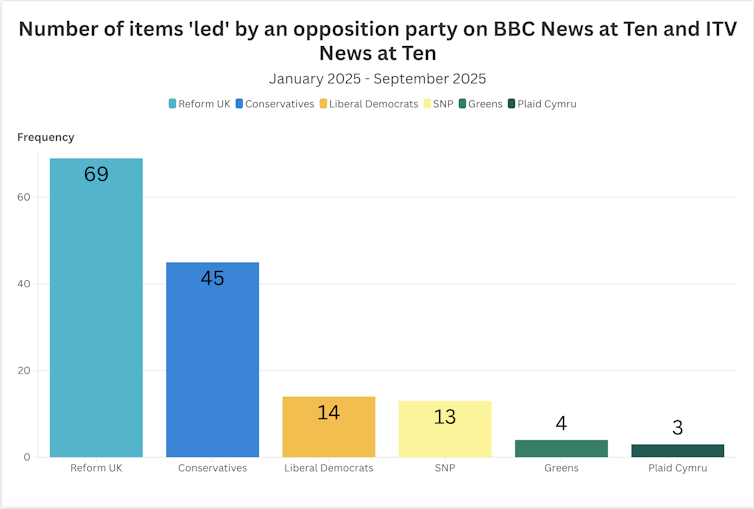 Number of items led by an opposition party on BBC News at Ten and ITV News at Ten.
Cardiff University, CC BY-NC-ND
Number of items led by an opposition party on BBC News at Ten and ITV News at Ten.
Cardiff University, CC BY-NC-ND
We also tracked how often a party was the leading focus of a broadcaster’s report. The Greens led four items – three on BBC and one on ITV. These stories related to the Greens’ May local election campaign, Zack Polanski winning the party leadership in September and the party conference in October. But neither BBC News at Ten and ITV News at Ten covered the announcement or build-up to the leadership contest.
In contrast, Reform UK led 69 items, Conservatives led 45 items, the Liberal Democrats led 14 items and the SNP led 13 items.
The Greens also appeared on only four episodes of BBC Question Time during 2025. That was about a third as often as the Liberal Democrats and Reform UK. Despite the leadership change, the subsequent surge in membership and the sustained rise in poll ratings (from 11% in August 2025 to 17% in December 2025), broadcast coverage of Greens did not increase at the end of 2025.
Read more: What Hannah Spencer’s historic win means for the Green party’s future
This shows a potential inequality in the treatment of the rising left and right parties. The BBC cited improvements in opinion polling as one of the factors behind the increased coverage of Reform UK, but the Green party’s popularity has not received anywhere near the same recognition.
In May 2025, news coverage of Reform UK increased substantially following its victories in local and mayoral elections, which broadcasters considered a sign that the party was now a major player in UK electoral politics. Our research even showed in September 2025 Reform UK was referenced on TV news more than the Conservatives, the party that is supposed to be the UK’s parliamentary official opposition.
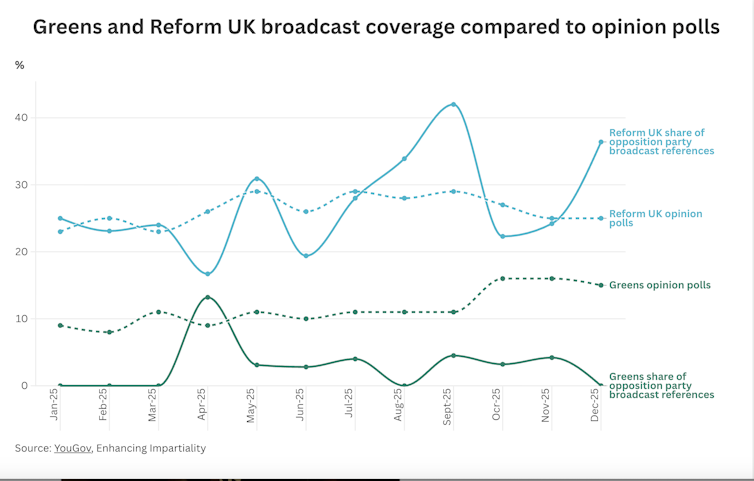 Greens and Reform UK TV news coverage compared to opinion polls.
Cardiff University, CC BY-NC-ND
Greens and Reform UK TV news coverage compared to opinion polls.
Cardiff University, CC BY-NC-ND
The question now is whether broadcasters will take the Green party’s victory in Gorton and Denton as a similar sign of its electoral significance and increase media coverage of the party.
While broadcasters have not broken any of the UK’s rules on due impartiality, our new research raises questions about how they have been interpreting impartiality in a new multi-party system.
Traditionally they have relied on allocating airtime according to parties with the largest number of MPs and total vote at the last general election. They have also factored in performances at the latest local, regional or devolved elections. But they now appear to making more subjective judgements about allocating airtime according to the opinion polls or the newsworthiness of parties.
Given the Greens’ growing popularity, their distinctive set of policies, charismatic leader and byelection victory, they might now look set to receive more media attention and scrutiny over the coming months.
- UK politics
- UK media
- by-elections
- Green Party
Events
Jobs
-
 Psychology Clinical Supervisor
-
Visiting Professor - 2027 Australia-Korea Chair in Australian Studies at Seoul National University
-
Department Chair and Associate Professor/Professor of Media and Communication
-
Research Fellow in Infectious Disease Epidemiology
-
1 year editorial cadetship
 Psychology Clinical Supervisor
 Visiting Professor - 2027 Australia-Korea Chair in Australian Studies at Seoul National University
 Department Chair and Associate Professor/Professor of Media and Communication
 Research Fellow in Infectious Disease Epidemiology
 1 year editorial cadetship
- Editorial Policies
- Community standards
- Republishing guidelines
- Analytics
- Our feeds
- Get newsletter
- Who we are
- Our charter
- Our team
- Partners and funders
- Resource for media
- Contact us
-
-
-
-
Copyright © 2010–2026, The Conversation