- Home
Edition
Africa Australia Brasil Canada Canada (français) Català España Europe France Global Indonesia New Zealand United Kingdom United States Skip to content Edition:
Global
Edition:
Global
- Africa
- Australia
- Brasil
- Canada
- Canada (français)
- Català
- España
- Europe
- France
- Indonesia
- New Zealand
- United Kingdom
- United States
Academic rigour, journalistic flair
Astrophysicists trace the origin of valuable metals in space, from colliding stars to merging galaxies
Published: March 10, 2026 3.03pm GMT
Simone Dichiara, Penn State, Eleonora Troja, University of Rome Tor Vergata
Authors
-
 Simone Dichiara
Assistant Research Professor of Astrophysics, Penn State
-
Eleonora Troja
Associate Professor of Astrophysics, University of Rome Tor Vergata
Disclosure statement
Simone Dichiara receives funding from the National Aeronautics and Space Administration and the Smithsonian Astrophysical Observatory
Eleonora Troja receives funding from European Research Council.
Partners

Penn State provides funding as a founding partner of The Conversation US.
View all partners
DOI
https://doi.org/10.64628/AAI.c3e3ansyp
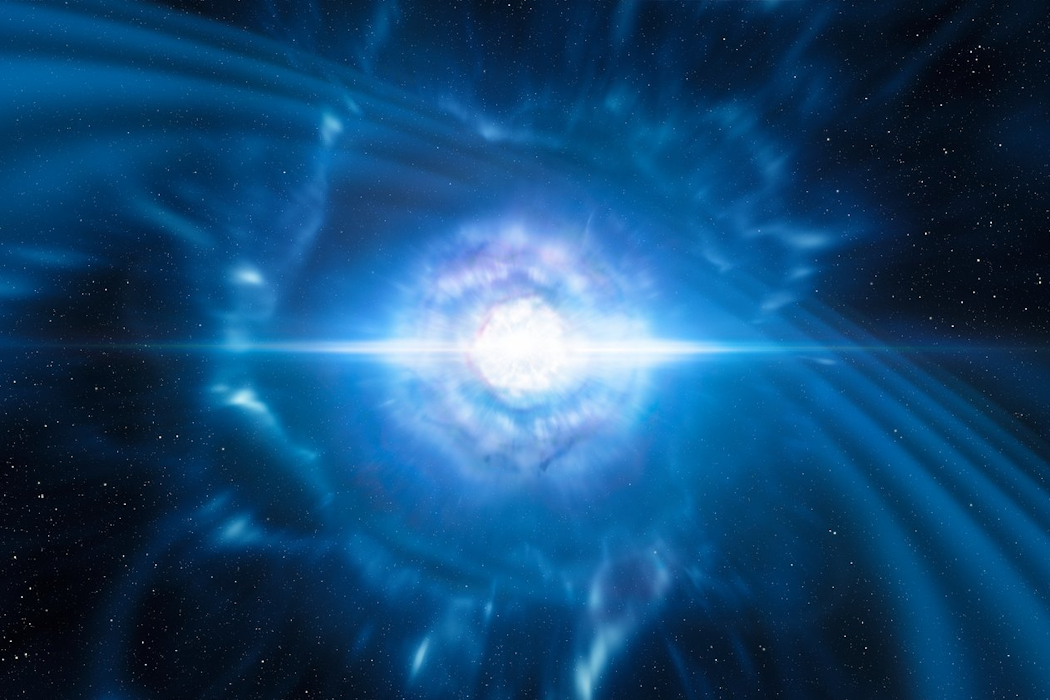
 This artist’s impression shows two tiny but very dense neutron stars at the point at which they merge and explode.
ESO/L. Calçada/M. Kornmesser, CC BY
https://theconversation.com/astrophysicists-trace-the-origin-of-valuable-metals-in-space-from-colliding-stars-to-merging-galaxies-272328
https://theconversation.com/astrophysicists-trace-the-origin-of-valuable-metals-in-space-from-colliding-stars-to-merging-galaxies-272328
Link copied
Share article
This artist’s impression shows two tiny but very dense neutron stars at the point at which they merge and explode.
ESO/L. Calçada/M. Kornmesser, CC BY
https://theconversation.com/astrophysicists-trace-the-origin-of-valuable-metals-in-space-from-colliding-stars-to-merging-galaxies-272328
https://theconversation.com/astrophysicists-trace-the-origin-of-valuable-metals-in-space-from-colliding-stars-to-merging-galaxies-272328
Link copied
Share article
Share article
Copy link Email Bluesky Facebook WhatsApp Messenger LinkedIn X (Twitter)Print article
Billions of light years away in a remote part of the universe, two neutron stars – the ultradense remnants of dead stars – collided. The catastropic cosmic event sent light and particles, including a sudden flash of gamma rays, streaming through the universe. These gamma rays traveled for 8.5 billion years before reaching Earth.
In a new study, our team of astrophysicists examined this gamma-ray signal. We learned that the stellar collision it came from was likely caused by an even more catastrophic encounter – a merger between two galaxies.
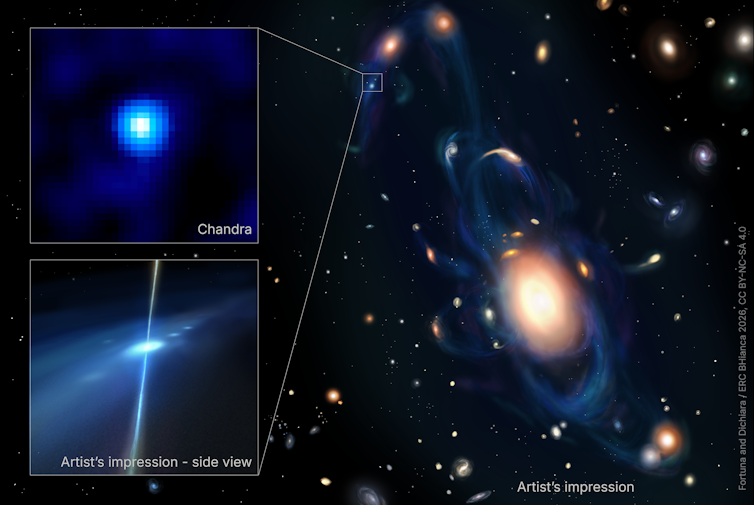 An illustration shows a galaxy merger, an event that leads to star collisions and the creation of valuable metals.
Fortuna, Dichiara/ERC BHianca 2026, CC BY-NC-SA 4.0, CC BY-SA
An illustration shows a galaxy merger, an event that leads to star collisions and the creation of valuable metals.
Fortuna, Dichiara/ERC BHianca 2026, CC BY-NC-SA 4.0, CC BY-SA
This is the first time astronomers associated this type of signal with such a large-scale galactic interaction. Our finding offers new insight into how stellar collisions spread metals across the universe.
Why it matters
When two neutron stars orbit each other and finally collide – a system called a binary neutron star merger – they produce the most powerful explosions in the universe. They release intense flashes of gamma rays, which astronomers call short gamma-ray bursts. They can release as much energy as our Sun will produce over its entire lifetime in less than a couple of seconds.
In binary neutron star mergers, two dense neutron stars orbit together and eventually collide. In the process, they send out bursts of gamma rays.These collisions can also eject debris pieces into space, which may create new radioactive elements when they collide. Many valuable elements, including gold and platinum, are forged in these mergers.
What makes the particular event, known as GRB 230906A, extraordinary is where it happened. Using NASA’s Chandra X-ray Observatory and the Hubble Space Telescope, we pinpointed the location of the explosion and identified its host galaxy as one of the faintest galaxies ever associated with a short GRB.
Observations obtained by the Very Large Telescope in Chile revealed that the burst occurred within a tangled system of interacting galaxies. Streams of stars and gas, torn out by past galactic encounters, stretched across the region. The gamma-ray burst lies directly within one of these tidal streams, suggesting it took place inside a tiny dwarf galaxy formed from the material stripped away from its host during a galaxy collision.
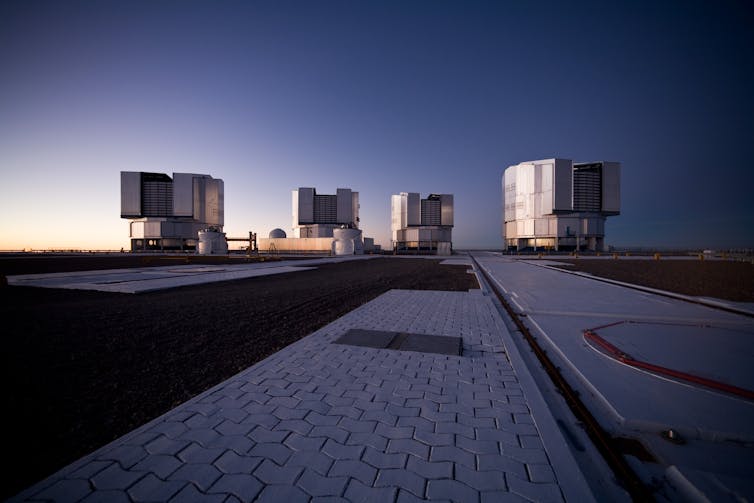 The Very Large Telescope in the Atacama Desert in Chile.
ESO/H.H.Heyer, CC BY
The Very Large Telescope in the Atacama Desert in Chile.
ESO/H.H.Heyer, CC BY
This is the first time that a binary neutron star merger has been linked to such an environment. This discovery reveals new homes for these cosmic collisions and shows they don’t just happen in big galaxies. It points to a new path for spreading heavy metals where we least expect them.
Our study traces the origin of these neutron star mergers back to the slow and far-reaching pull of gravity between galaxies. It tells us more about where these extraordinary events can take place and, most importantly, how the elements that make up our world came to be.
What still isn’t known
As this explosion was far away, our instruments could not measure which elements were forged in the collision. Similar bright explosions may be produced not only by binary neutron star mergers, but also by mergers involving neutron stars and black holes, or even other types of compact stellar remnants such as white dwarfs, the leftover cores of Sun-like stars.
What’s next
New powerful observatories, such as the James Webb Space Telescope and the Nancy Grace Roman Space Telescope, will enable the discovery and detailed study of distant mergers responsible for producing heavy elements.
Future advanced X-ray missions, such as NewAthena and AXIS, will increase our ability to identify these types of explosions.
These new capabilities will move side by side with the development of the next generation of gravitational wave detectors: Einstein Telescope and Cosmic Explorer. These will allow us to decipher the nature of these mergers, marking a new era for multimessenger astronomy. Together, these telescopes will be essential for understanding how the elements that make up our world are formed.
- Astronomy
- Astrophysics
- Stars
- Gamma ray bursts
- Space telescopes
- Galaxies
- New research
- Research Brief
- STEEHM new research
Events
Jobs
-
 Lecturer, Literacy
-
Research Fellow in Animal Welfare Science
-
Visiting Professor - 2027 Australia-Korea Chair in Australian Studies at Seoul National University
-
Department Chair and Associate Professor/Professor of Media and Communication
-
1 year editorial cadetship
 Lecturer, Literacy
 Research Fellow in Animal Welfare Science
 Visiting Professor - 2027 Australia-Korea Chair in Australian Studies at Seoul National University
 Department Chair and Associate Professor/Professor of Media and Communication
 1 year editorial cadetship
- Editorial Policies
- Community standards
- Republishing guidelines
- Analytics
- Our feeds
- Get newsletter
- Who we are
- Our charter
- Our team
- Partners and funders
- Resource for media
- Contact us
-
-
-
-
Copyright © 2010–2026, The Conversation