
- Home
Edition
Africa Australia Brasil Canada Canada (français) Català España Europe France Global Indonesia New Zealand United Kingdom United States Skip to content Edition:
Global
Edition:
Global
- Africa
- Australia
- Brasil
- Canada
- Canada (français)
- Català
- España
- Europe
- France
- Indonesia
- New Zealand
- United Kingdom
- United States
Academic rigour, journalistic flair
 This virtue helps you figure out when and how to apply the other virtues in real, varying situations.
Cavan Images/Cavan via Getty Images
Making good choices when life gets messy – practical wisdom relies on human judgment, not rules
Published: March 10, 2026 12.45pm GMT
Tim Hulsey, University of Tennessee
This virtue helps you figure out when and how to apply the other virtues in real, varying situations.
Cavan Images/Cavan via Getty Images
Making good choices when life gets messy – practical wisdom relies on human judgment, not rules
Published: March 10, 2026 12.45pm GMT
Tim Hulsey, University of Tennessee
Author
-
 Tim Hulsey
Associate Professor of Psychology, University of Tennessee
Disclosure statement
Tim Hulsey does not work for, consult, own shares in or receive funding from any company or organisation that would benefit from this article, and has disclosed no relevant affiliations beyond their academic appointment.
Partners

University of Tennessee provides funding as a member of The Conversation US.
View all partners
DOI
https://doi.org/10.64628/AAI.wt3g3xcuy
https://theconversation.com/making-good-choices-when-life-gets-messy-practical-wisdom-relies-on-human-judgment-not-rules-271928 https://theconversation.com/making-good-choices-when-life-gets-messy-practical-wisdom-relies-on-human-judgment-not-rules-271928 Link copied Share articleShare article
Copy link Email Bluesky Facebook WhatsApp Messenger LinkedIn X (Twitter)Print article
A few semesters into my teaching career as a psychology professor, I uncovered a cheating ring. I determined who the ringleader was and called him to my office.
He admitted that he had illicitly obtained a copy of the exam and shared it with other students. He began to cry, telling me he was from a single parent family, the first in his family to go to college, and that his mother would be crushed if he was dismissed from the university for academic dishonesty.
I did not know what to do. I was angry at what he had done, but I also felt sorry for his situation. For reasons I still don’t fully understand, I decided to call his mother. When I told her what he had done, she apologized repeatedly, then said coldly, “Let me speak to him.”
I don’t know what she said, but as the color drained from his face and he was reduced to repeatedly saying, “Yes, ma’am,” I assumed he was being read the riot act. After he hung up, he headed home to, I suspect, more severe punishment than the university could have given. He received a “0” on the exam and an official reprimand in his student file, but I’m willing to bet that the most important lesson he learned didn’t come from the university or me.
Though I didn’t yet know the word, the decision to call his mother was an example of phronesis, an ancient Greek word usually translated as “practical wisdom.” It refers to the ability to make good decisions in real-life situations, especially when there are no clear rules or easy answers.
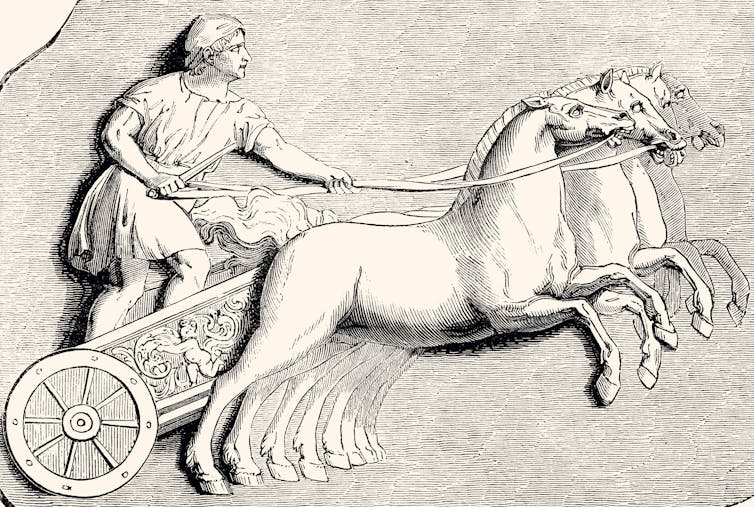 Like a charioteer steering the horses, phronesis guides you in how to apply the other virtues, like courage, justice and generosity.
pictore/DigitalVision Vectors via Getty Images
Like a charioteer steering the horses, phronesis guides you in how to apply the other virtues, like courage, justice and generosity.
pictore/DigitalVision Vectors via Getty Images
Charioteer of the virtues, guiding them all
Phronesis provides you with the ability to deliberate well about what is good and bad in specific circumstances. Unlike theoretical knowledge (sophia) or technical skill (techne), phronesis is about judgment – how to choose the right action at the right time for the right reasons.
When you think about wisdom, maybe you imagine a philosopher pondering big questions or a scientist unlocking the secrets of the universe. But phronesis is a different kind of wisdom, one that is less about abstract ideas and more about navigating the messy, unpredictable realities of everyday life. Phronesis helps you live well, not by following rules, but by making wise choices in the face of complexity. It’s what allows you to turn knowledge into action that is then beneficial.
Phronesis is a central component of the virtue approach to character development and morality first described by Aristotle. Virtues like courage, generosity, justice and temperance tell you what goals you should aim for, but they don’t tell you how much, when or in what way you should act in a specific situation. Phronesis helps you think through and decide the right means to achieve the right ends in the moment.
Aristotle called phronesis “the charioteer of the virtues” because it provides the guidance system that ensures the other virtues are applied correctly in real life. As he put it, “It is impossible to be good in the strict sense without practical wisdom.”
Let’s take the example of courage. Everyone wants to be brave and stand up for their values. However, without phronesis, too much courage may become recklessness, or too little courage could result in cowardice. Phronesis allows you to know when to take a risk and when to hold back.
Or consider justice, the virtue of treating others fairly. Phronesis allows you to choose what is fair in a specific situation. Virtues set the goals – for instance, “be courageous” or “be just” – but phronesis determines the right way to achieve them.
Practice phronesis in the face of complexity
Developing phronesis takes time and effort. It requires experience, reflection and careful reasoning. Because phronesis is social, it thrives in environments where people share their perspectives and challenge each other’s assumptions.
You don’t have to be a philosopher or a scientist to practice phronesis. Modern life is full of complexity. We are regularly faced with questions that don’t have clear answers.
 Staying up past bedtime to watch a big game as a family has value that a strict adherence to rules would overlook.
AzmanL/E+ via Getty Images
Staying up past bedtime to watch a big game as a family has value that a strict adherence to rules would overlook.
AzmanL/E+ via Getty Images
Picture a parent who must decide whether to enforce bedtime or allow a child to stay up for a special family occasion. The rule says bedtime is nonnegotiable, but practical wisdom reminds us of the value of shared family experiences.
Or consider a manager who notices an employee missing deadlines. Instead of simply reprimanding them, they might ask what’s going on and discover a family emergency. They could adjust expectations and offer support, balancing fairness with compassion.
These kinds of decisions reflect practical wisdom because they anticipate future needs, not just rules or consequences.
In a world obsessed with data and efficiency, phronesis reminds us that human judgment still matters. Algorithms can optimize processes, but they can’t weigh moral values or capture the subtleties of human relationships. Whether in education, health care, business or politics, decisions that affect lives require more than technical expertise. They require wisdom.
Phronesis counters the illusion that life’s problems have simple, one-size-fits-all solutions. It helps us realize that good judgment takes time, empathy and reflection. So, the next time you face a tough decision, pause and ask: What’s the wise thing to do?
- Philosophy
- Morality
- Virtues
- Moral psychology
- Wisdom
- Judgment
- Character
- Character development
- Character virtue
Events
Jobs
-
 Lecturer, Literacy
-
Research Fellow in Animal Welfare Science
-
Visiting Professor - 2027 Australia-Korea Chair in Australian Studies at Seoul National University
-
Department Chair and Associate Professor/Professor of Media and Communication
-
1 year editorial cadetship
 Lecturer, Literacy
 Research Fellow in Animal Welfare Science
 Visiting Professor - 2027 Australia-Korea Chair in Australian Studies at Seoul National University
 Department Chair and Associate Professor/Professor of Media and Communication
 1 year editorial cadetship
- Editorial Policies
- Community standards
- Republishing guidelines
- Analytics
- Our feeds
- Get newsletter
- Who we are
- Our charter
- Our team
- Partners and funders
- Resource for media
- Contact us
-
-
-
-
Copyright © 2010–2026, The Conversation